Using AI as Defense
Be the first to know about every new letter.
No spam, unsubscribe anytime.
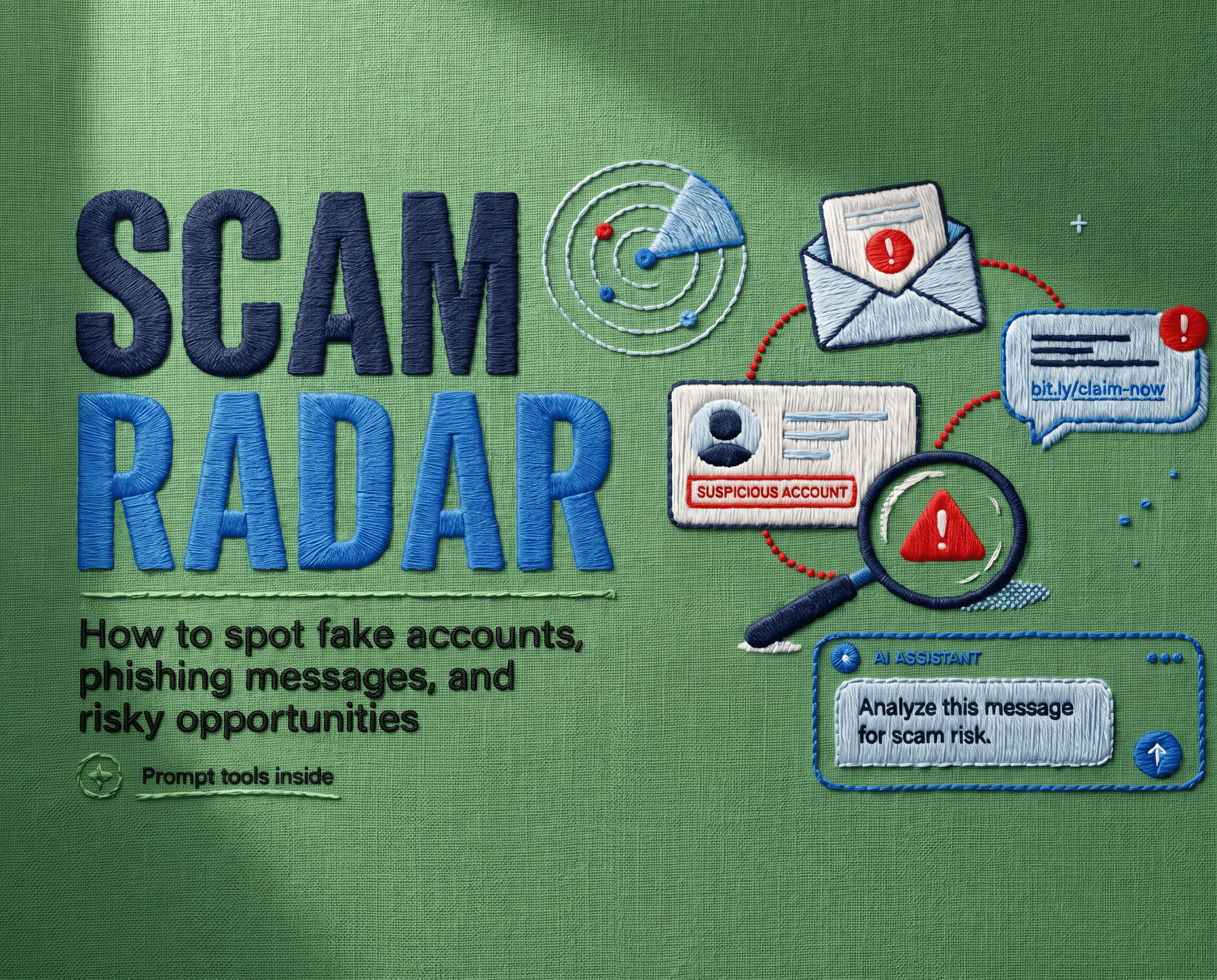
A message comes in. An account follows you. A brand reaches out. A client inquiry lands in your inbox. A job offer appears. A text says your account has a problem. Someone says they want to collaborate.
Scams do not always show up looking dangerous. Sometimes they show up looking like an opportunity.
Not everything suspicious is a scam. Some people are just bad at communication. Some businesses are messy. Some opportunities are real but unclear.
But when money, identity, access, urgency, or secrecy enters the conversation, you have to slow the moment down.
A real opportunity can survive verification. A scam needs momentum.
First: Check the Account
Before you respond to an account, ask yourself:
Can I prove this person or brand is who they say they are without using anything they sent me?
That means you do not use their link first. You do not call the number they texted you. You do not trust the profile just because it looks professional.
You check from the outside.
Search the person. Search the company. Go to the official website manually. Compare the email domain. Look at the account history. See who tags them. See who they interact with. Look for signs that the account existed before this offer appeared.
Prompt to use:
Act as a digital trust investigator. I am reviewing an online account that may be real, fake, impersonating someone, or risky.

Analyze the account using these categories:
1. Identity consistency
2. Account history
3. Profile credibility
4. Link and domain risk
5. Communication behavior
6. Pressure tactics
7. Signs of impersonation
8. What I should verify independently before responding

Here is what I know about the account:
[Paste username, bio, screenshots description, messages, link style, follower count, account age, and anything unusual.]

Give me a risk rating: Low, Medium, High, or Critical. Then give me the safest next action
Second: Check the Message
If the message is asking you to click, verify, send a code, download a file, confirm a payment, pay a fee, move to another app, or share personal information, the message is not just communication.
It is an action funnel.
You need to ask:
What does this message want me to do?
Because the scam is usually hidden inside the action.
Prompt to use:
Act as a phishing and scam detection assistant. Analyze the message below.

Identify:
1. The emotional trigger being used
2. The action the sender wants me to take
3. Any suspicious links, phone numbers, attachments, or requests
4. Whether the sender is creating urgency, fear, reward, authority, or secrecy
5. What information they may be trying to steal
6. What I should do instead of replying or clicking

Message:
[Paste message here]

Give me:
- Risk rating: Low / Medium / High / Critical
- Scam type guess
- Safest next step
- A rewritten safe response if responding is appropriate
Third: Check the Opportunity
This is where people get caught.
Opportunity is one of the easiest emotional disguises for a scam.
The person may flatter you. They may say they love your work. They may say you are selected. They may say the budget is high. They may say they need someone exactly like you.
And maybe they do.
But before you emotionally accept the opportunity, examine the structure.
Prompt to use:
Act as a business risk analyst. I received an opportunity and need to determine if it is legitimate, disorganized, or potentially a scam.

Analyze:
1. What the opportunity claims to offer
2. What they are asking from me
3. Whether the exchange is balanced
4. Whether money, identity, access, or reputation is at risk
5. Whether the process matches how a real business would operate
6. What independent verification steps I should take
7. What questions I should ask before continuing

Opportunity details:
[Paste the message, offer, job post, brand deal, DM, email, or summary.]

Give me:
- Risk rating
- Scam pattern it resembles, if any
- Missing information
- Safe next step
- A professional reply that protects me
Safe Reply Templates
Sometimes the best response is no response.
But when you do want to reply, keep it calm, professional, and protective.
When you want to verify without accusing them:
Thanks for reaching out. Before I move forward, I verify all opportunities through official channels. Can you send the company website, your official email address, and any public page that confirms this campaign or role
When they send a suspicious link:
I don’t click links from unsolicited messages. I’ll go through the official website or app directly to check this
When they ask for a verification code:
I don’t share verification codes with anyone. If this is connected to an account issue, I’ll handle it directly through the official platform
When they rush you:
I don’t make financial or account decisions under time pressure. I’ll review this independently and follow up if it checks out
When a brand deal feels off:
Thank you for considering me. Please send the campaign brief, company website, official brand contact email, payment terms, and contract for review
When a job offer feels suspicious:
Before sharing any personal information, I need to verify the company, hiring manager, official job posting, compensation structure, and onboarding process
Master Prompt: Scam Situation Analyzer
Use this when something feels off, but you cannot tell if you are being cautious or dramatic.
Act as my digital scam detection advisor. I want to evaluate a situation without overreacting and without ignoring risk.

Classify this as one of the following:
1. Likely legitimate
2. Legitimate but operationally messy
3. Suspicious
4. Likely scam
5. Critical threat: do not engage

Analyze the situation through:
- Identity verification
- Message behavior
- Emotional manipulation
- Money risk
- Identity/data risk
- Account access risk
- Reputation risk
- Platform-switching risk
- Link/attachment risk
- What a legitimate version would look like

Situation:
[Paste everything here.]

Then give me:
1. Risk rating
2. Biggest red flags
3. What I should not do
4. What I should verify independently
5. Safe next action
6. A short reply I can send, if replying is safe
Final Thought
The digital world is full of opportunity.
But opportunity now comes through the same doors as impersonation, phishing, fake clients, fake jobs, fake brand deals, fake accounts, fake support teams, and fake urgency.
You do not need to panic. You do not need to assume everyone is lying. You do not need to shut every door.
You just need to stop letting strangers set the pace.
Because a real opportunity can wait while you verify.
A scam cannot.
Let's chat again soon...
Gibz
A message comes in. An account follows you. A brand reaches out. A client inquiry lands in your inbox. A job offer appears. A text says your account has a problem. Someone says they want to collaborate.
Scams do not always show up looking dangerous. Sometimes they show up looking like an opportunity.
Not everything suspicious is a scam. Some people are just bad at communication. Some businesses are messy. Some opportunities are real but unclear.
But when money, identity, access, urgency, or secrecy enters the conversation, you have to slow the moment down.
A real opportunity can survive verification. A scam needs momentum.
First: Check the Account
Before you respond to an account, ask yourself:
Can I prove this person or brand is who they say they are without using anything they sent me?
That means you do not use their link first. You do not call the number they texted you. You do not trust the profile just because it looks professional.
You check from the outside.
Search the person. Search the company. Go to the official website manually. Compare the email domain. Look at the account history. See who tags them. See who they interact with. Look for signs that the account existed before this offer appeared.
Prompt to use:
Act as a digital trust investigator. I am reviewing an online account that may be real, fake, impersonating someone, or risky.

Analyze the account using these categories:
1. Identity consistency
2. Account history
3. Profile credibility
4. Link and domain risk
5. Communication behavior
6. Pressure tactics
7. Signs of impersonation
8. What I should verify independently before responding

Here is what I know about the account:
[Paste username, bio, screenshots description, messages, link style, follower count, account age, and anything unusual.]

Give me a risk rating: Low, Medium, High, or Critical. Then give me the safest next action
Second: Check the Message
If the message is asking you to click, verify, send a code, download a file, confirm a payment, pay a fee, move to another app, or share personal information, the message is not just communication.
It is an action funnel.
You need to ask:
What does this message want me to do?
Because the scam is usually hidden inside the action.
Prompt to use:
Act as a phishing and scam detection assistant. Analyze the message below.

Identify:
1. The emotional trigger being used
2. The action the sender wants me to take
3. Any suspicious links, phone numbers, attachments, or requests
4. Whether the sender is creating urgency, fear, reward, authority, or secrecy
5. What information they may be trying to steal
6. What I should do instead of replying or clicking

Message:
[Paste message here]

Give me:
- Risk rating: Low / Medium / High / Critical
- Scam type guess
- Safest next step
- A rewritten safe response if responding is appropriate
Third: Check the Opportunity
This is where people get caught.
Opportunity is one of the easiest emotional disguises for a scam.
The person may flatter you. They may say they love your work. They may say you are selected. They may say the budget is high. They may say they need someone exactly like you.
And maybe they do.
But before you emotionally accept the opportunity, examine the structure.
Prompt to use:
Act as a business risk analyst. I received an opportunity and need to determine if it is legitimate, disorganized, or potentially a scam.

Analyze:
1. What the opportunity claims to offer
2. What they are asking from me
3. Whether the exchange is balanced
4. Whether money, identity, access, or reputation is at risk
5. Whether the process matches how a real business would operate
6. What independent verification steps I should take
7. What questions I should ask before continuing

Opportunity details:
[Paste the message, offer, job post, brand deal, DM, email, or summary.]

Give me:
- Risk rating
- Scam pattern it resembles, if any
- Missing information
- Safe next step
- A professional reply that protects me
Safe Reply Templates
Sometimes the best response is no response.
But when you do want to reply, keep it calm, professional, and protective.
When you want to verify without accusing them:
Thanks for reaching out. Before I move forward, I verify all opportunities through official channels. Can you send the company website, your official email address, and any public page that confirms this campaign or role
When they send a suspicious link:
I don’t click links from unsolicited messages. I’ll go through the official website or app directly to check this
When they ask for a verification code:
I don’t share verification codes with anyone. If this is connected to an account issue, I’ll handle it directly through the official platform
When they rush you:
I don’t make financial or account decisions under time pressure. I’ll review this independently and follow up if it checks out
When a brand deal feels off:
Thank you for considering me. Please send the campaign brief, company website, official brand contact email, payment terms, and contract for review
When a job offer feels suspicious:
Before sharing any personal information, I need to verify the company, hiring manager, official job posting, compensation structure, and onboarding process
Master Prompt: Scam Situation Analyzer
Use this when something feels off, but you cannot tell if you are being cautious or dramatic.
Act as my digital scam detection advisor. I want to evaluate a situation without overreacting and without ignoring risk.

Classify this as one of the following:
1. Likely legitimate
2. Legitimate but operationally messy
3. Suspicious
4. Likely scam
5. Critical threat: do not engage

Analyze the situation through:
- Identity verification
- Message behavior
- Emotional manipulation
- Money risk
- Identity/data risk
- Account access risk
- Reputation risk
- Platform-switching risk
- Link/attachment risk
- What a legitimate version would look like

Situation:
[Paste everything here.]

Then give me:
1. Risk rating
2. Biggest red flags
3. What I should not do
4. What I should verify independently
5. Safe next action
6. A short reply I can send, if replying is safe
Final Thought
The digital world is full of opportunity.
But opportunity now comes through the same doors as impersonation, phishing, fake clients, fake jobs, fake brand deals, fake accounts, fake support teams, and fake urgency.
You do not need to panic. You do not need to assume everyone is lying. You do not need to shut every door.
You just need to stop letting strangers set the pace.
Because a real opportunity can wait while you verify.
A scam cannot.
Let's chat again soon...
Gibz
A message comes in. An account follows you. A brand reaches out. A client inquiry lands in your inbox. A job offer appears. A text says your account has a problem. Someone says they want to collaborate.
Scams do not always show up looking dangerous. Sometimes they show up looking like an opportunity.
Not everything suspicious is a scam. Some people are just bad at communication. Some businesses are messy. Some opportunities are real but unclear.
But when money, identity, access, urgency, or secrecy enters the conversation, you have to slow the moment down.
A real opportunity can survive verification. A scam needs momentum.
First: Check the Account
Before you respond to an account, ask yourself:
Can I prove this person or brand is who they say they are without using anything they sent me?
That means you do not use their link first. You do not call the number they texted you. You do not trust the profile just because it looks professional.
You check from the outside.
Search the person. Search the company. Go to the official website manually. Compare the email domain. Look at the account history. See who tags them. See who they interact with. Look for signs that the account existed before this offer appeared.
Prompt to use:
Act as a digital trust investigator. I am reviewing an online account that may be real, fake, impersonating someone, or risky.

Analyze the account using these categories:
1. Identity consistency
2. Account history
3. Profile credibility
4. Link and domain risk
5. Communication behavior
6. Pressure tactics
7. Signs of impersonation
8. What I should verify independently before responding

Here is what I know about the account:
[Paste username, bio, screenshots description, messages, link style, follower count, account age, and anything unusual.]

Give me a risk rating: Low, Medium, High, or Critical. Then give me the safest next action
Second: Check the Message
If the message is asking you to click, verify, send a code, download a file, confirm a payment, pay a fee, move to another app, or share personal information, the message is not just communication.
It is an action funnel.
You need to ask:
What does this message want me to do?
Because the scam is usually hidden inside the action.
Prompt to use:
Act as a phishing and scam detection assistant. Analyze the message below.

Identify:
1. The emotional trigger being used
2. The action the sender wants me to take
3. Any suspicious links, phone numbers, attachments, or requests
4. Whether the sender is creating urgency, fear, reward, authority, or secrecy
5. What information they may be trying to steal
6. What I should do instead of replying or clicking

Message:
[Paste message here]

Give me:
- Risk rating: Low / Medium / High / Critical
- Scam type guess
- Safest next step
- A rewritten safe response if responding is appropriate
Third: Check the Opportunity
This is where people get caught.
Opportunity is one of the easiest emotional disguises for a scam.
The person may flatter you. They may say they love your work. They may say you are selected. They may say the budget is high. They may say they need someone exactly like you.
And maybe they do.
But before you emotionally accept the opportunity, examine the structure.
Prompt to use:
Act as a business risk analyst. I received an opportunity and need to determine if it is legitimate, disorganized, or potentially a scam.

Analyze:
1. What the opportunity claims to offer
2. What they are asking from me
3. Whether the exchange is balanced
4. Whether money, identity, access, or reputation is at risk
5. Whether the process matches how a real business would operate
6. What independent verification steps I should take
7. What questions I should ask before continuing

Opportunity details:
[Paste the message, offer, job post, brand deal, DM, email, or summary.]

Give me:
- Risk rating
- Scam pattern it resembles, if any
- Missing information
- Safe next step
- A professional reply that protects me
Safe Reply Templates
Sometimes the best response is no response.
But when you do want to reply, keep it calm, professional, and protective.
When you want to verify without accusing them:
Thanks for reaching out. Before I move forward, I verify all opportunities through official channels. Can you send the company website, your official email address, and any public page that confirms this campaign or role
When they send a suspicious link:
I don’t click links from unsolicited messages. I’ll go through the official website or app directly to check this
When they ask for a verification code:
I don’t share verification codes with anyone. If this is connected to an account issue, I’ll handle it directly through the official platform
When they rush you:
I don’t make financial or account decisions under time pressure. I’ll review this independently and follow up if it checks out
When a brand deal feels off:
Thank you for considering me. Please send the campaign brief, company website, official brand contact email, payment terms, and contract for review
When a job offer feels suspicious:
Before sharing any personal information, I need to verify the company, hiring manager, official job posting, compensation structure, and onboarding process
Master Prompt: Scam Situation Analyzer
Use this when something feels off, but you cannot tell if you are being cautious or dramatic.
Act as my digital scam detection advisor. I want to evaluate a situation without overreacting and without ignoring risk.

Classify this as one of the following:
1. Likely legitimate
2. Legitimate but operationally messy
3. Suspicious
4. Likely scam
5. Critical threat: do not engage

Analyze the situation through:
- Identity verification
- Message behavior
- Emotional manipulation
- Money risk
- Identity/data risk
- Account access risk
- Reputation risk
- Platform-switching risk
- Link/attachment risk
- What a legitimate version would look like

Situation:
[Paste everything here.]

Then give me:
1. Risk rating
2. Biggest red flags
3. What I should not do
4. What I should verify independently
5. Safe next action
6. A short reply I can send, if replying is safe
Final Thought
The digital world is full of opportunity.
But opportunity now comes through the same doors as impersonation, phishing, fake clients, fake jobs, fake brand deals, fake accounts, fake support teams, and fake urgency.
You do not need to panic. You do not need to assume everyone is lying. You do not need to shut every door.
You just need to stop letting strangers set the pace.
Because a real opportunity can wait while you verify.
A scam cannot.
Let's chat again soon...
Gibz
My mission is to
Help you create and earn on your terms.
No spam, unsubscribe anytime.