The Global Cafeteria


Be the first to know about every new letter.
No spam, unsubscribe anytime.
The cultural narrative around digital life is not balanced...it’s skewed negative. Headlines warn us that social media breeds bullying, deepens loneliness, and disconnects us from “real life.”
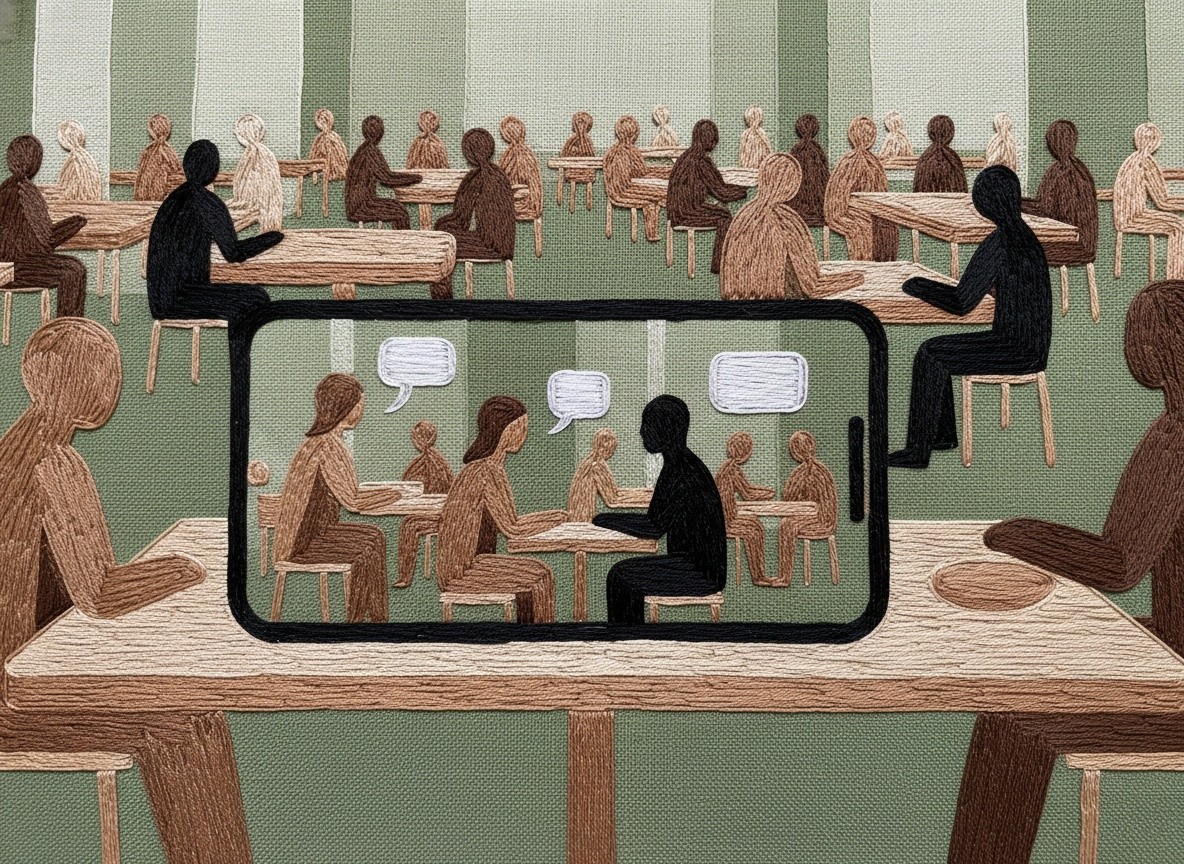
But bullying doesn’t change its sting depending on the setting. In a cafeteria, it’s the laughter behind your back or the empty seat you’re not allowed to take. Online, it’s the cruel comment left to linger or the silence when your words are ignored. Different spaces, same rejection. Yet notice the double standard: when it happens online, the platform itself is condemned. Social media is branded “toxic.” But when it happens in person, no one blames the cafeteria. We don’t say, because one kid was mocked at lunch, no one should ever eat there again.
But maybe we’re asking the wrong question. The real issue isn’t the cafeteria or the feed, the monitor or the moderator, the tool or the algorithm. The question is bigger: what kind of humans did we raise?
Think about the cafeteria. Every school had monitors, teachers, or principals trying to keep peace. And yet things still slipped through, laughter at someone’s expense, an empty seat someone wasn’t allowed to take. Social media works the same way. Platforms have moderators, algorithms, and guidelines, but bullying and cruelty still get by. Humans miss things. Machines miss things. The point isn’t whether the space is safe enough, but what people choose to do once they’re in it.
Because here’s the harder truth: anonymity makes cruelty easier. Behind a fake profile or a screen name, people sometimes act in ways they never would face-to-face. But that’s not a platform problem, that’s a people problem. Why, when given the safety of being unseen, do so many choose meanness over kindness? What level of teaching, leadership, and modeling do we need to instill so that even when no one’s watching, people still feel love toward their neighbor?
And now comes AI. For the first time in history, words themselves have immediate creative power. A single prompt can design, write, brainstorm, or build in seconds. Skills that once took years to master are suddenly within reach. This means more people than ever will step into the role of creator. More people will have the tools to influence, to build, to spread ideas at scale.
So the question returns: what kind of humans did we raise?
For leaders, it’s a responsibility question. What behaviors are we modeling, rewarding, and passing down?
For communities, it’s a belonging question. Are we teaching empathy and care — or indifference?
For innovators, it’s an opportunity question. Will we use these tools to create connection and progress, or to amplify division?
The cafeteria and the feed aren’t the problem. AI isn’t the problem. The problem — and the possibility — lies in us.
Because at the end of the day, the legacy of this era won’t be measured by whether we built smarter machines. It will be measured by whether we raised better humans. Humans who choose to help, to connect, to create — and to leave spaces, digital or physical, stronger than they found them.
Let’s chat again soon…
Gibz
The cultural narrative around digital life is not balanced...it’s skewed negative. Headlines warn us that social media breeds bullying, deepens loneliness, and disconnects us from “real life.”
But bullying doesn’t change its sting depending on the setting. In a cafeteria, it’s the laughter behind your back or the empty seat you’re not allowed to take. Online, it’s the cruel comment left to linger or the silence when your words are ignored. Different spaces, same rejection. Yet notice the double standard: when it happens online, the platform itself is condemned. Social media is branded “toxic.” But when it happens in person, no one blames the cafeteria. We don’t say, because one kid was mocked at lunch, no one should ever eat there again.
But maybe we’re asking the wrong question. The real issue isn’t the cafeteria or the feed, the monitor or the moderator, the tool or the algorithm. The question is bigger: what kind of humans did we raise?
Think about the cafeteria. Every school had monitors, teachers, or principals trying to keep peace. And yet things still slipped through, laughter at someone’s expense, an empty seat someone wasn’t allowed to take. Social media works the same way. Platforms have moderators, algorithms, and guidelines, but bullying and cruelty still get by. Humans miss things. Machines miss things. The point isn’t whether the space is safe enough, but what people choose to do once they’re in it.
Because here’s the harder truth: anonymity makes cruelty easier. Behind a fake profile or a screen name, people sometimes act in ways they never would face-to-face. But that’s not a platform problem, that’s a people problem. Why, when given the safety of being unseen, do so many choose meanness over kindness? What level of teaching, leadership, and modeling do we need to instill so that even when no one’s watching, people still feel love toward their neighbor?
And now comes AI. For the first time in history, words themselves have immediate creative power. A single prompt can design, write, brainstorm, or build in seconds. Skills that once took years to master are suddenly within reach. This means more people than ever will step into the role of creator. More people will have the tools to influence, to build, to spread ideas at scale.
So the question returns: what kind of humans did we raise?
For leaders, it’s a responsibility question. What behaviors are we modeling, rewarding, and passing down?
For communities, it’s a belonging question. Are we teaching empathy and care — or indifference?
For innovators, it’s an opportunity question. Will we use these tools to create connection and progress, or to amplify division?
The cafeteria and the feed aren’t the problem. AI isn’t the problem. The problem — and the possibility — lies in us.
Because at the end of the day, the legacy of this era won’t be measured by whether we built smarter machines. It will be measured by whether we raised better humans. Humans who choose to help, to connect, to create — and to leave spaces, digital or physical, stronger than they found them.
Let’s chat again soon…
Gibz
The cultural narrative around digital life is not balanced...it’s skewed negative. Headlines warn us that social media breeds bullying, deepens loneliness, and disconnects us from “real life.”
But bullying doesn’t change its sting depending on the setting. In a cafeteria, it’s the laughter behind your back or the empty seat you’re not allowed to take. Online, it’s the cruel comment left to linger or the silence when your words are ignored. Different spaces, same rejection. Yet notice the double standard: when it happens online, the platform itself is condemned. Social media is branded “toxic.” But when it happens in person, no one blames the cafeteria. We don’t say, because one kid was mocked at lunch, no one should ever eat there again.
But maybe we’re asking the wrong question. The real issue isn’t the cafeteria or the feed, the monitor or the moderator, the tool or the algorithm. The question is bigger: what kind of humans did we raise?
Think about the cafeteria. Every school had monitors, teachers, or principals trying to keep peace. And yet things still slipped through, laughter at someone’s expense, an empty seat someone wasn’t allowed to take. Social media works the same way. Platforms have moderators, algorithms, and guidelines, but bullying and cruelty still get by. Humans miss things. Machines miss things. The point isn’t whether the space is safe enough, but what people choose to do once they’re in it.
Because here’s the harder truth: anonymity makes cruelty easier. Behind a fake profile or a screen name, people sometimes act in ways they never would face-to-face. But that’s not a platform problem, that’s a people problem. Why, when given the safety of being unseen, do so many choose meanness over kindness? What level of teaching, leadership, and modeling do we need to instill so that even when no one’s watching, people still feel love toward their neighbor?
And now comes AI. For the first time in history, words themselves have immediate creative power. A single prompt can design, write, brainstorm, or build in seconds. Skills that once took years to master are suddenly within reach. This means more people than ever will step into the role of creator. More people will have the tools to influence, to build, to spread ideas at scale.
So the question returns: what kind of humans did we raise?
For leaders, it’s a responsibility question. What behaviors are we modeling, rewarding, and passing down?
For communities, it’s a belonging question. Are we teaching empathy and care — or indifference?
For innovators, it’s an opportunity question. Will we use these tools to create connection and progress, or to amplify division?
The cafeteria and the feed aren’t the problem. AI isn’t the problem. The problem — and the possibility — lies in us.
Because at the end of the day, the legacy of this era won’t be measured by whether we built smarter machines. It will be measured by whether we raised better humans. Humans who choose to help, to connect, to create — and to leave spaces, digital or physical, stronger than they found them.
Let’s chat again soon…
Gibz
My mission is to
Help you create and earn on your terms.
No spam, unsubscribe anytime.
My mission is to
Help you create and earn on your terms.
No spam, unsubscribe anytime.
My mission is to
Help you create and earn on your terms.
No spam, unsubscribe anytime.