Surface Tension
Be the first to know about every new letter.
No spam, unsubscribe anytime.
For decades, entertainment was shared ground.
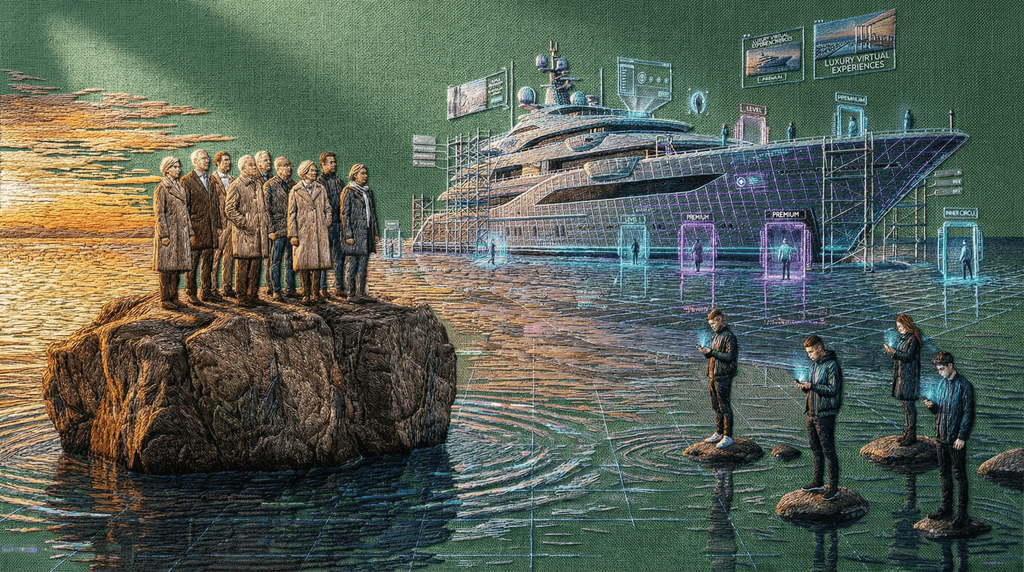
If two people connected over a song, a show, a film they were standing on the same rock. Around them was water: different politics, backgrounds, opinions. But the rock held. It supported conversation. It created familiarity. It allowed movement from one side to another, without requiring much from us.
For Baby Boomers, that rock was massive and stable. Cultural consumption was concentrated. A few dominant broadcast networks, films released in theaters, television scheduled at fixed times, music distributed through limited channels. The result was collective memory. You could walk into a room and assume most people had stood on the same surface.
Then the internet arrived, and shattered the rock into pebbles.
Today, two people can spend hours consuming media without touching a single shared reference point. We’re no longer standing together by default. We’re navigating alone.
This fragmentation explains the power of viral moments. When something goes viral, it briefly reconstructs a rock. Millions gather. The collective returns...temporarily.
Which leads to a strategic question:
What happens when there is no natural rock left?
The next surface won’t be a public rock.
It will be a privately owned vessel.
Video games have already demonstrated the architecture. Entire universes built from code. Identity structured. Access tiered. Status visible. You pay to enter. You pay to upgrade. You pay to remain relevant inside the system. The economy is immersive and self-contained.
Now imagine that infrastructure applied to luxury at scale.
When companies with eight-figure advertising budgets realize they can redirect spend from renting attention on social platforms to owning an immersive world, the capital will move. Not toward louder campaigns, but toward controlled environments.
And honestly, we’ve grown used to waiting for ground. Waiting for platforms. Waiting for permission to stand somewhere that feels solid.
History gives us a pattern.
There was a time when land in the United States felt vast and free. Territory seemed abundant. Over time, that land was claimed, structured, monetized. Ownership concentrated. Access tightened. Scarcity wasn’t immediate. It was gradual.
Digital space is following a similar arc.
We are mapping behavior. Tracking attention. Charting where people gather. Watching which pebbles draw crowds. And when terrain is mapped, it can be owned.
The future won’t remove our need for connection.
It will structure it. Price it. Design it.
Some people will board the vessel. Some will build it.
I fear that the future will be less about finding common ground, and more about finding ways to own it.
Let’s chat again soon...
Gibz
My mission is to
Help you create and earn on your terms.
No spam, unsubscribe anytime.