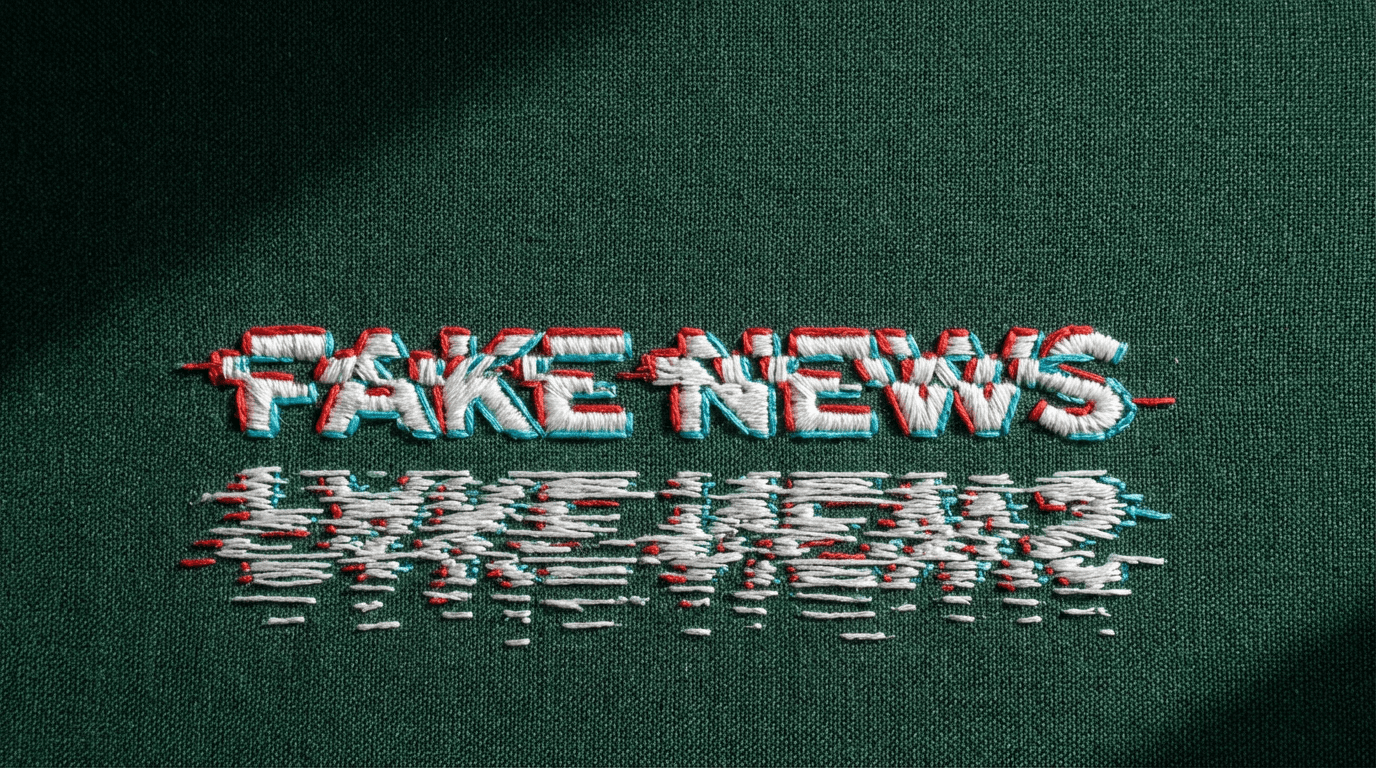
Fake News


Be the first to know about every new letter.
No spam, unsubscribe anytime.
From the earliest days of television, news programming relied on visual and auditory cues to signal credibility: the authoritative desk, the strategic lighting, the reassuring tone, the predictable pacing.
A Population Shaped by Predictability
Media conditioning wasn’t malicious; it was functional.
Consistency builds trust.
Patterns create legibility.
A predictable communication style reassures the public that complex global events can be understood.
But predictability has an unintended effect:
it trains the audience to respond automatically.
Certain colors signal urgency.
Certain fonts imply authority.
Certain tones communicate certainty, even when the information is evolving.
In time, audiences learned not just what news is…
but what news should look like.
This is where our reflexes were formed.
AI Inherited the Blueprint
Today, AI can replicate these cues with remarkable precision.
Not because AI is inherently deceptive,
but because the media spent half a century standardizing the aesthetics of truth.
Once something is standardized, it becomes simple to imitate.
A fake news broadcast looks convincing because the real ones have followed the same structure for decades. A fabricated political clip resonates because it uses the same rhetorical patterns our ears have been trained to interpret as “leadership.”
Even AI-generated Ring camera footage gains credibility because we trust the unpolished aesthetics of domestic surveillance.
AI’s real sophistication is not technological…it is contextual.
It leverages the reflexes we’ve been developing since childhood.
The Quiet Irony
The media never anticipated losing exclusive control over these formats.
The rhythms, tones, and visual patterns that once fortified trust were designed for a world with limited publishers and high editorial oversight.
Now, anyone can access the same communicative vocabulary.
The result is not chaos, but confusion.
The cues that once safeguarded reliable information now belong to everyone. Including those with no intention of informing the public at all.
Where We Go From Here
We are simply at a turning point…
One where understanding the architecture of our attention is as essential as understanding the information itself.
If the past taught us how to read the news,
the future will ask us to read the signals behind it.
Let’s chat again soon…
Gibz
From the earliest days of television, news programming relied on visual and auditory cues to signal credibility: the authoritative desk, the strategic lighting, the reassuring tone, the predictable pacing.
A Population Shaped by Predictability
Media conditioning wasn’t malicious; it was functional.
Consistency builds trust.
Patterns create legibility.
A predictable communication style reassures the public that complex global events can be understood.
But predictability has an unintended effect:
it trains the audience to respond automatically.
Certain colors signal urgency.
Certain fonts imply authority.
Certain tones communicate certainty, even when the information is evolving.
In time, audiences learned not just what news is…
but what news should look like.
This is where our reflexes were formed.
AI Inherited the Blueprint
Today, AI can replicate these cues with remarkable precision.
Not because AI is inherently deceptive,
but because the media spent half a century standardizing the aesthetics of truth.
Once something is standardized, it becomes simple to imitate.
A fake news broadcast looks convincing because the real ones have followed the same structure for decades. A fabricated political clip resonates because it uses the same rhetorical patterns our ears have been trained to interpret as “leadership.”
Even AI-generated Ring camera footage gains credibility because we trust the unpolished aesthetics of domestic surveillance.
AI’s real sophistication is not technological…it is contextual.
It leverages the reflexes we’ve been developing since childhood.
The Quiet Irony
The media never anticipated losing exclusive control over these formats.
The rhythms, tones, and visual patterns that once fortified trust were designed for a world with limited publishers and high editorial oversight.
Now, anyone can access the same communicative vocabulary.
The result is not chaos, but confusion.
The cues that once safeguarded reliable information now belong to everyone. Including those with no intention of informing the public at all.
Where We Go From Here
We are simply at a turning point…
One where understanding the architecture of our attention is as essential as understanding the information itself.
If the past taught us how to read the news,
the future will ask us to read the signals behind it.
Let’s chat again soon…
Gibz
From the earliest days of television, news programming relied on visual and auditory cues to signal credibility: the authoritative desk, the strategic lighting, the reassuring tone, the predictable pacing.
A Population Shaped by Predictability
Media conditioning wasn’t malicious; it was functional.
Consistency builds trust.
Patterns create legibility.
A predictable communication style reassures the public that complex global events can be understood.
But predictability has an unintended effect:
it trains the audience to respond automatically.
Certain colors signal urgency.
Certain fonts imply authority.
Certain tones communicate certainty, even when the information is evolving.
In time, audiences learned not just what news is…
but what news should look like.
This is where our reflexes were formed.
AI Inherited the Blueprint
Today, AI can replicate these cues with remarkable precision.
Not because AI is inherently deceptive,
but because the media spent half a century standardizing the aesthetics of truth.
Once something is standardized, it becomes simple to imitate.
A fake news broadcast looks convincing because the real ones have followed the same structure for decades. A fabricated political clip resonates because it uses the same rhetorical patterns our ears have been trained to interpret as “leadership.”
Even AI-generated Ring camera footage gains credibility because we trust the unpolished aesthetics of domestic surveillance.
AI’s real sophistication is not technological…it is contextual.
It leverages the reflexes we’ve been developing since childhood.
The Quiet Irony
The media never anticipated losing exclusive control over these formats.
The rhythms, tones, and visual patterns that once fortified trust were designed for a world with limited publishers and high editorial oversight.
Now, anyone can access the same communicative vocabulary.
The result is not chaos, but confusion.
The cues that once safeguarded reliable information now belong to everyone. Including those with no intention of informing the public at all.
Where We Go From Here
We are simply at a turning point…
One where understanding the architecture of our attention is as essential as understanding the information itself.
If the past taught us how to read the news,
the future will ask us to read the signals behind it.
Let’s chat again soon…
Gibz
My mission is to
Help you create and earn on your terms.
No spam, unsubscribe anytime.
My mission is to
Help you create and earn on your terms.
No spam, unsubscribe anytime.
My mission is to
Help you create and earn on your terms.
No spam, unsubscribe anytime.